Preliminary design contracts
Preliminary study and formation of the main indicators of the project.

Methodology
An overview of proven methodologies for maximizing project value through phased execution, early optimization, cost management, EPC strategy, and industry best practices across the project lifecycle.
01 · Phased approach
The most common approach to capital projects is the phased approach — proven to be profitable and to best meet the requirements of the project and its shareholders.
Main advantages
The essence of the approach
02 · Scope per phase
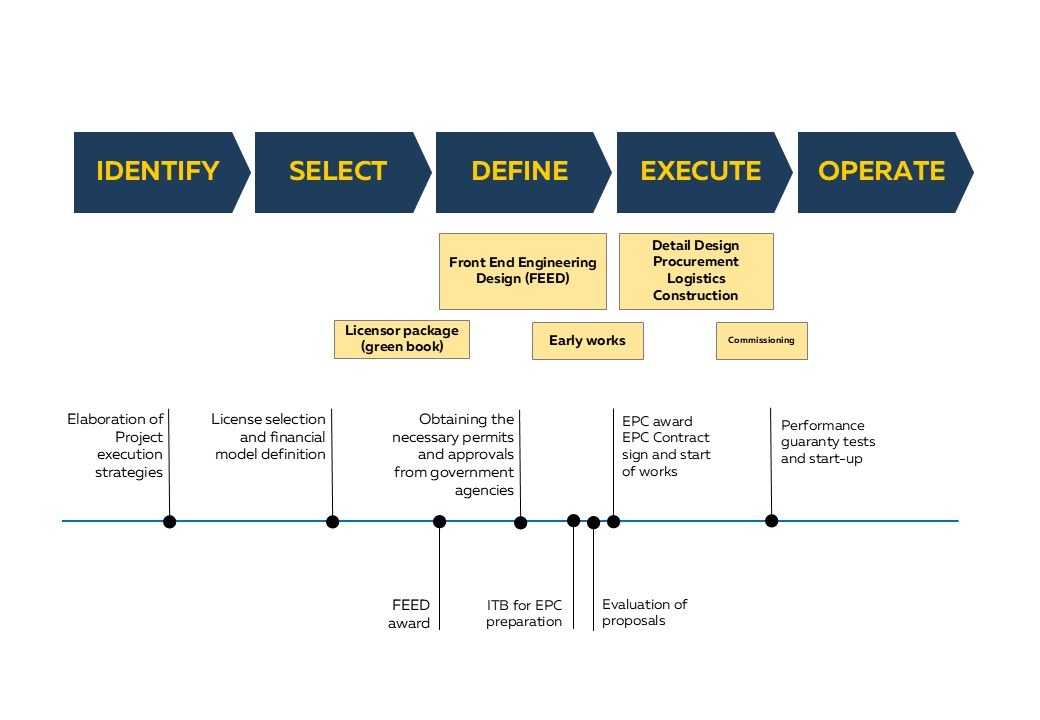
A brief description of the essence of work and the results delivered at each phase.
Assess project feasibility and alignment with company strategy. Result: project framework and business goals.
Compare project execution options. Result: case study report.
Elaborate the selected option. Result: final project framework, cost and schedule.
Detailed design, procurement, construction, and start-up (EPC). Result: working production at final price and deadline.
Operate the asset with finished products and profit. Result: operational activities.
03 · Value & cost
The positive effect on project cost is greatest at the initial stages, when it is still possible to change project indicators and make the right technical and commercial decisions. The ability to influence performance drops significantly after the final investment decision.
It is critically important to involve a professional team at the preliminary study stage to ensure the value of the project is formed. The cost of qualitative early study is many times less than the cost of implementation — and leads to many times greater results.
04 · Accuracy by phase
Engineering, procurement, construction, cost, and schedule maturity grow as the project advances (level of development 0–2% → 50–95%, cost estimate classes 5 → 1 per AACE methodology).
| Discipline | Identify | Select | Define | Execute |
|---|---|---|---|---|
| Engineering | Conceptual design · Pre-FEED | Case Study · BEDP, FEED · ITB package | Detail Design | As-built documentation |
| Procurement | Procurement strategy · Analogs | Benchmarking · Requests for quotation | Bidding · Contracting · Execution | Operation procurement |
| Construction | Construction strategy | Strategy analysis · Requests for quotation | Bidding · Contracting · Execution | — |
| Cost class | Class 5 (−50% / +100%) | Class 4 (−30% / +50%) | Class 3 (−20% / +30%) | Class 2–1 (−15/+30% · −10/+15%) |
| Schedule | Level 1 | Level 2 | Level 3 | Level 4 |
05 · Best practices
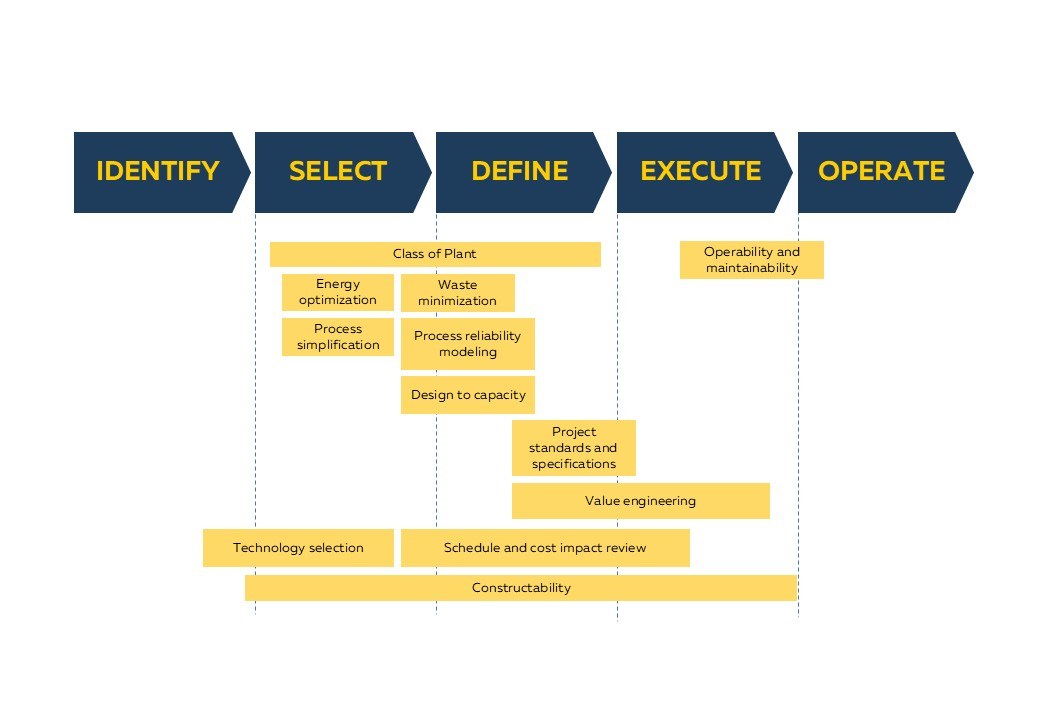
The main Value Improvement Practices should be applied in the preliminary phases of the project, where they deliver the largest impact on value and cost.
06 · Contracting
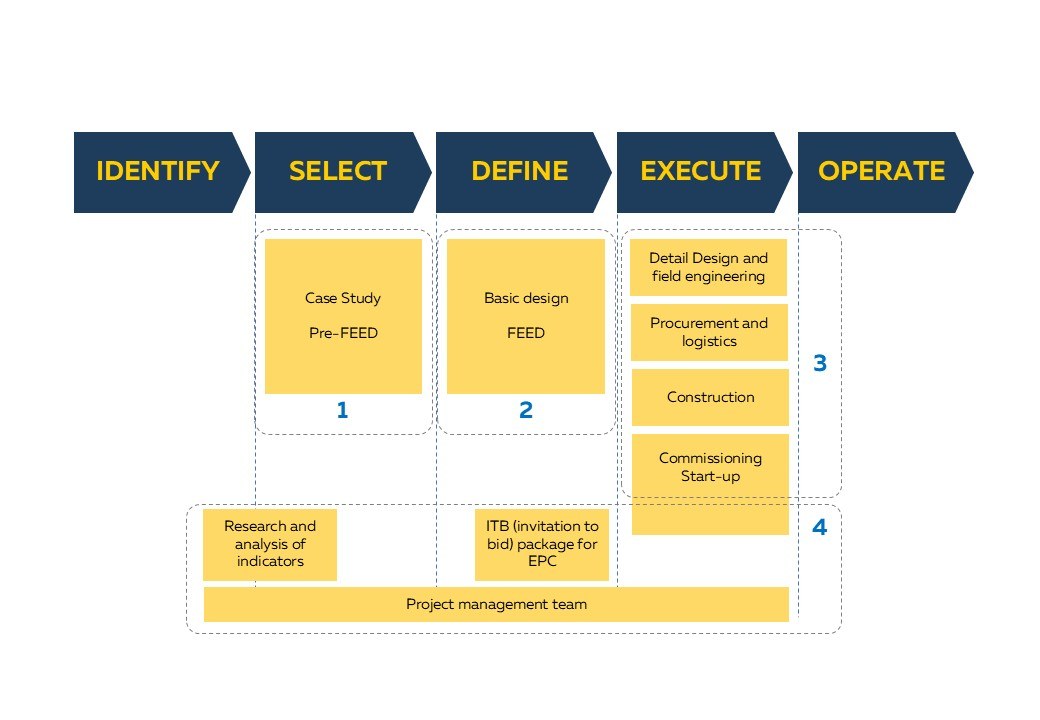
Preliminary study and formation of the main indicators of the project.
Elaboration of the main technical solutions for determining the budget.
Determined by a competition based on the ITB. The main cost of the project is formed.
Concluded by the Owner with third parties for independent performance of works.
07 · Team & cost structure
On the example of a project worth 1 billion USD — how cost and team size grow across the four phases. *of procurement cost · **of construction cost.
| Indicator | Identify | Select | Define | Execute |
|---|---|---|---|---|
| Total project execution cost | 0.1% | 0.5% | 1.4% | 98% |
| Engineering cost | 0.1% | 0.5% | 1.4% | 8% |
| Procurement & logistics cost | — | — | 10%* | 30% |
| Construction cost | — | — | 5%** | 50% |
| Owner's project team (people) | 16 | 38 | 73 | 177 |
| Contractor's project team (people) | 20 | 90 | 200 | 7000 |
08 · Organization
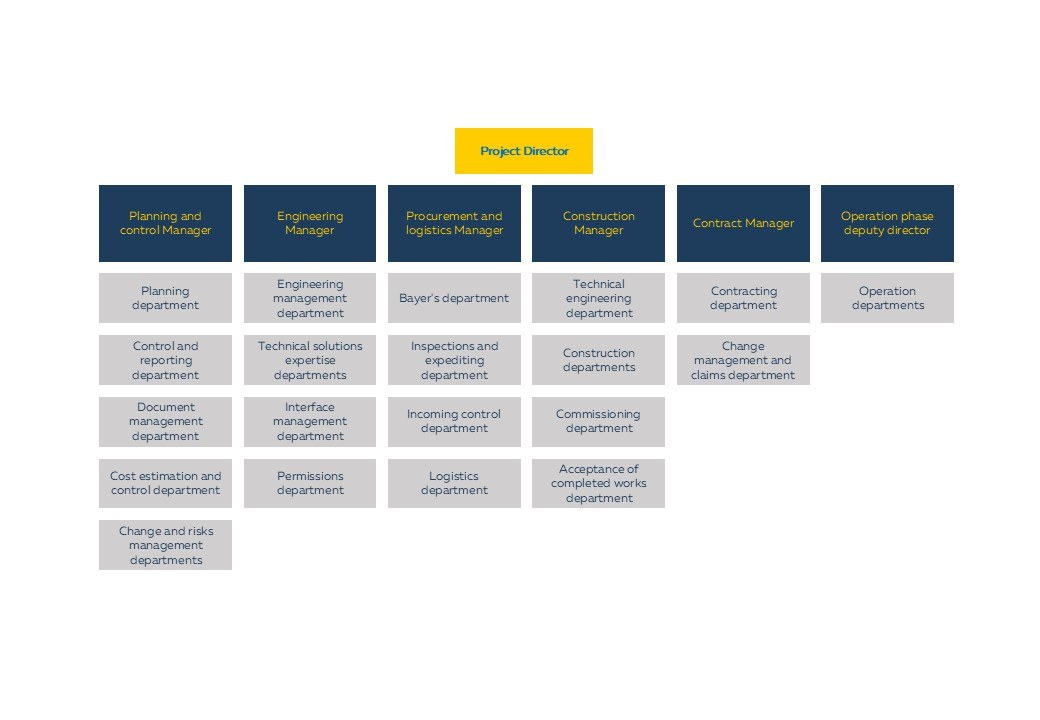
The structure of the main divisions of the project team at phase 4 (Execute). The number of specialists and departments changes depending on the execution phase.